
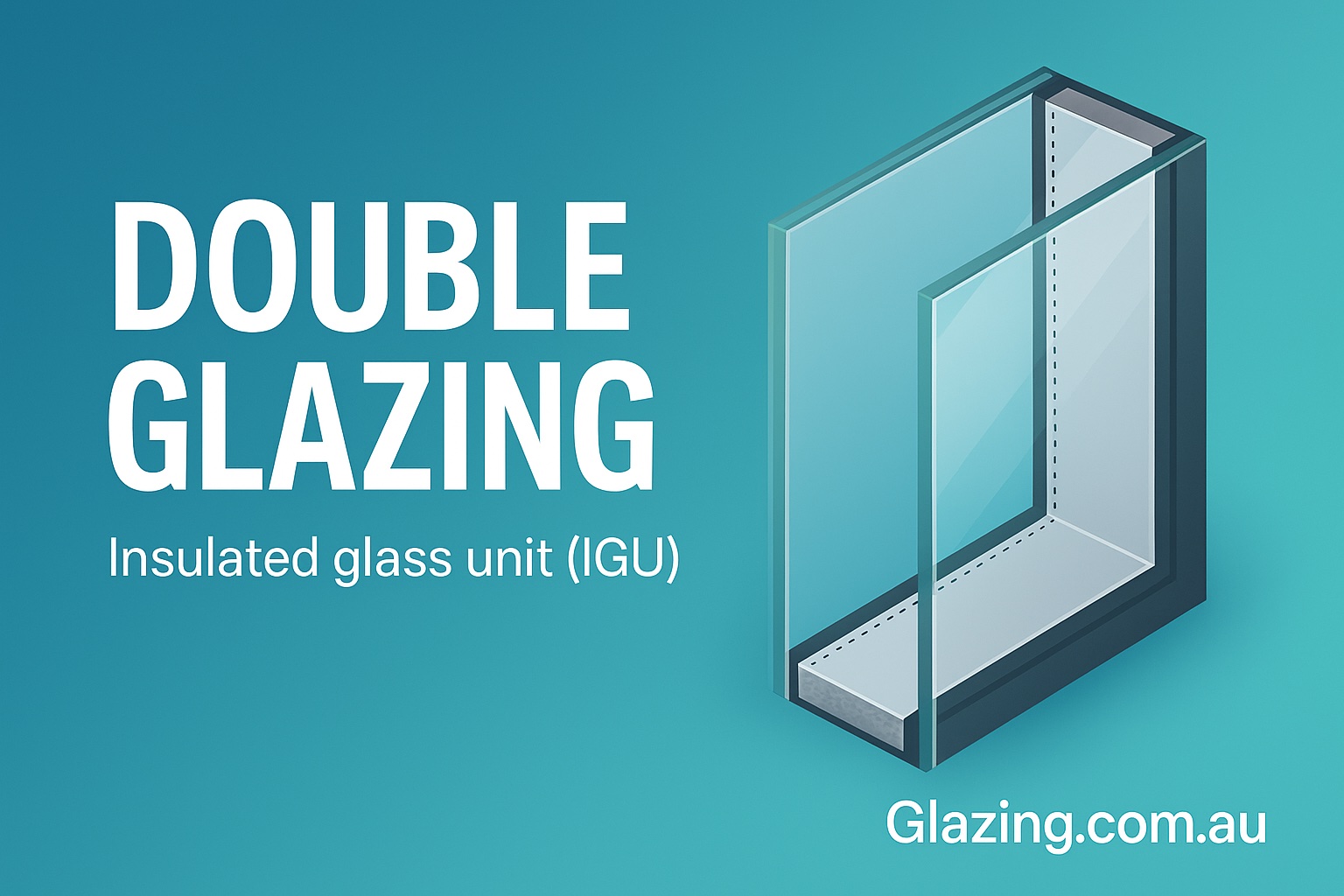
Two panes of glass separated by a sealed spacer to create an insulating air or argon cavity. Delivers lower U-values, better comfort and improved condensation resistance when correctly detailed.
Definition
An insulated glass unit (IGU) comprises two glass panes, a spacer bar with desiccant, and dual edge seals that form a dry, sealed cavity (air or inert gas such as argon). Performance is verified using AFRC/WERS ratings.
Surface numbering (quick map)
Surfaces are counted from outside to inside: #1 = exterior face of outer pane, #2 = cavity face of outer pane, #3 = cavity face of inner pane, #4 = room face of inner pane. Solar-control Low-E is typically on #2; designs favouring winter gain may use #3.
What drives performance
- Low-E coatings: Cut radiant heat transfer (usually on #2 or #3).
- Cavity & gas: Argon improves insulation vs air. Practical cavity widths are commonly 10–16 mm; mid-teens often balance thermal performance and thickness in AU builds.
- Spacer: Warm-edge spacers reduce edge heat loss and help with condensation resistance.
- Seals & desiccant: Primary (PIB) + secondary (silicone/polysulphide) seals retain gas and keep the cavity dry.
- Frames: Thermally-broken or uPVC frames and airtight installation stop frame losses undoing the IGU gains.
Why it matters in Australia
IGUs are a common pathway to meeting NCC 2022 energy-efficiency targets (NatHERS/WERS for housing, Section J for apartments/non-residential). Select to certified U-value and SHGC for your climate, orientation and shading.
Installation & durability
- Manufacture and installation must comply with AS/NZS 4666 (Insulating Glass Units).
- Detail glazing to drain water or be watertight so the edge seal isn’t exposed to standing moisture.
- Use compatible sealants; where edges are UV-exposed (e.g., structural silicone joints), specify UV-resistant secondary seals.
Condensation reality check
IGUs keep the inner pane warmer, lowering the chance of interior condensation. Building-wide condensation management (ventilation, membranes, airtightness) is still required under the NCC.
Sources
- YourHome (AUS Gov) — Glazing, U-value & SHGC: yourhome.gov.au
- NCC 2022 — Energy efficiency (housing) & Section J: Part H6 · Spec 37
- AGWA — Guide to Energy Efficiency & WERS (AFRC-aligned): agwa.com.au (PDF)
- National Glass (AU) — IGU overview & notes: nationalglass.com.au · compatibility PDF
- Viridian — Air vs Argon cavities; spacer types & warm-edge: air vs argon · spacers
- NCC 2022 — Condensation management & handbook: Part F8 · ABCB handbook
AU specification tip: pair an IGU with the right Low-E surface (#2 or #3), a warm-edge spacer, and thermally-broken frames. Verify AFRC/WERS ratings for your exact build and climate zone.